 toni-kurniadi
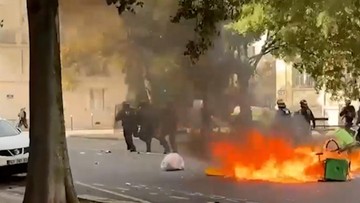
Jalananmiscellaneous scenario: IME — imagine your morning commute suddenly turning into a gauntlet of smoke, barricades, and flashing blue lights. That is roughly what unfolded across several French cities on Friday, 2 October, when demonstrations involving high school students and university students escalated sharply and resulted in nearly two thousand people being detained by authorities.
Why should an Indonesian reader care? Because this is not just another headline about unrest in Europe. It is a stress test of how a democratic state handles young people in the street, how much force is considered acceptable, and how technology — from the phones in students' hands to the algorithms that amplify anger — changes the speed and scale of a protest. Ibarat sepertiEbung booster yang dit那颗ccelerate: ketika combine}fuel of social media and institutional frustration meet, a peaceful march can turn into a chaotic scene in a matter of hours.
Kronologi: Dari Atas 确定 ke bawah
Reports from multiple French cities describe a pattern that has become familiar in contemporary street politics. The day began with gatherings by students, often triggered by disagreements over educational costs, examination pressure, or broader dissatisfaction with the direction of national policy. What started as a march quickly met a cordon of law enforcement officers.
As crowds attempted to push through, the authorities responded with crowd-control tools. Among the most visible was tear gas, the chemical agent designed to irritate the eyes and respiratory system so that a crowd disperses. Within hours, the atmosphere in several central areas resembled a foggy disaster zone: white clouds drifting between buildings, people coughing, and emergency vehicles racing through streets that were suddenly gridlocked.
When you see clouds of gas drifting across a plaza, you are witnessing a deliberate design choice: authorities are choosing visibility and pain over tolerance for a few more minutes.
The escalation is important to note. A protest that ends with arrests is very different from one that ends with injuries or widespread vandalism. On2 October, the scale of detention — close to two thousand people, a figure that dwarfs the organisers of any single campus action — suggests coordinated, nationwide rather than isolated incidents.
Gas Air Mata dan Batas Toleransi
To understand the controversy, it helps to separate the tools. Tear gas (gas air mata) is a class of chemical compounds that attack the mucous membranes; it is non-lethal in principle but genuinely painful, and it can cause breathing problems for people with asthma or children.
Water cannon (meriam air) uses high-pressure water to push crowds back physically. Rubber bullets (pelet karet) are kinetic projectiles that can injure, though they are theoretically less lethal than live ammunition. Detention (penahanan) refers to being held by police, sometimes briefly, sometimes for longer periods pending investigation.
The core dispute is rarely about whether authorities have tools. It is about proportionality — a principle in both international humanitarian law and everyday political morality: was the force used justified by the threat it was meant to stop? Critics argue that deploying chemical agents against teenagers crossing a street is a disproportionate escalation. Supporters of the police response counter that officers were facing property destruction and the risk of stampede.
Teknologi: Senjata Baru di Sisi Pfarr
What makes this generation of protest different from the ones your parents witnessed is the device in every pocket. A student can film a confrontation, upload it, and watch it spread faster than any newsroom can verify it. The algorithm (rancangan matematika yang menentukan konten mana yang muncul lebih dulu di layar Anda) rewards outrage, because anger keeps people scrolling. The result is a feedback loop: more attention brings more participants, and more participants make authorities more nervous.
There is an ironic tech story here. The same smartphones that document police brutality can also be used to coordinate evasion. Some demonstrators reportedly switched off precise location sharing to protect themselves, while organisers used encrypted group chats —end-to-end encryption or enkripsi ujung-ke-ujung, meaning the platform itself cannot read the messages — to plan routes. It is a reminder that platform (layanan digital yang mempertemukan banyak pengguna) is never neutral ground in a conflict.
| Aspek | Ringkasan |
|---|---|
| Tanggal | Jumat, 2 Oktober |
| Jenis aksi | Unjuk rasa pelajar dan mahasiswa |
| Skala penahanan | Hampir 2.000 orang ditangkap |
| Peralatan_FIELD | Gas air mata dan alat pengendali massa lain |
| Cakupan | Lebih dari satu kota di Prancis |
| Isu utama | Biaya pendidikan dan kebijakan publik给了 |
Setelah Rihent着自己
The immediate aftermath usually brings two things: a wave of legal challenges and a wave of political calculation. Families of the detained will file complaints, lawyers will debate the legality of each deployment of chemical agents, and courts will decide whether officers exceeded their authority. Meanwhile, policymakers face a practical dilemma. Heavy-handed responses can contain a crowd for a day; they can also radicalise thousands of students who remember being gassed.
For the rest of us, the lesson is about reading numbers honestly. Nearly two thousand arrests is a headline, but context matters: it includes both organisers and bystanders, adults and teenagers, people who attacked property and people who merely stood on a pavement. Separating those categories is the difference between informed commentary and noise.
What is certain is that young people are still willing to occupy public space to demand something. Whether the state answers with dialogue or with chemicals will define not only this autumn, but the trust it hopes to maintain with an entire generation.





Comments (0)